
Introduction
Credit cards are convenient, flexible, and widely used, but many people do not fully understand how interest works. You may have seen the term APR on your credit card statement or in an offer, but the real cost of carrying a balance can be confusing.
Understanding how credit card interest works is essential if you want to avoid unnecessary debt and use credit responsibly. Interest can make small balances grow faster than expected, and knowing how it is calculated helps you stay in control of your finances.
This guide explains credit card interest in simple terms so you can make smarter decisions and avoid costly mistakes.
What Is Credit Card Interest?
Credit card interest is the cost of borrowing money when you do not pay your balance in full by the due date. When you carry a balance from one month to the next, the credit card company charges interest on the remaining amount.
Think of it as a fee for using the bank’s money. The longer you take to pay it back, the more interest you may owe.
What Does APR Mean?
APR stands for Annual Percentage Rate. It represents the yearly cost of borrowing money on your credit card, expressed as a percentage.
For example, if your card has a 20% APR, that does not mean you pay 20% interest every month. Instead, the rate is divided across the year. However, because interest is often calculated daily, the total cost can still add up quickly.
Different transactions can have different APRs, such as purchases, cash advances, and balance transfers.
How Interest Is Calculated
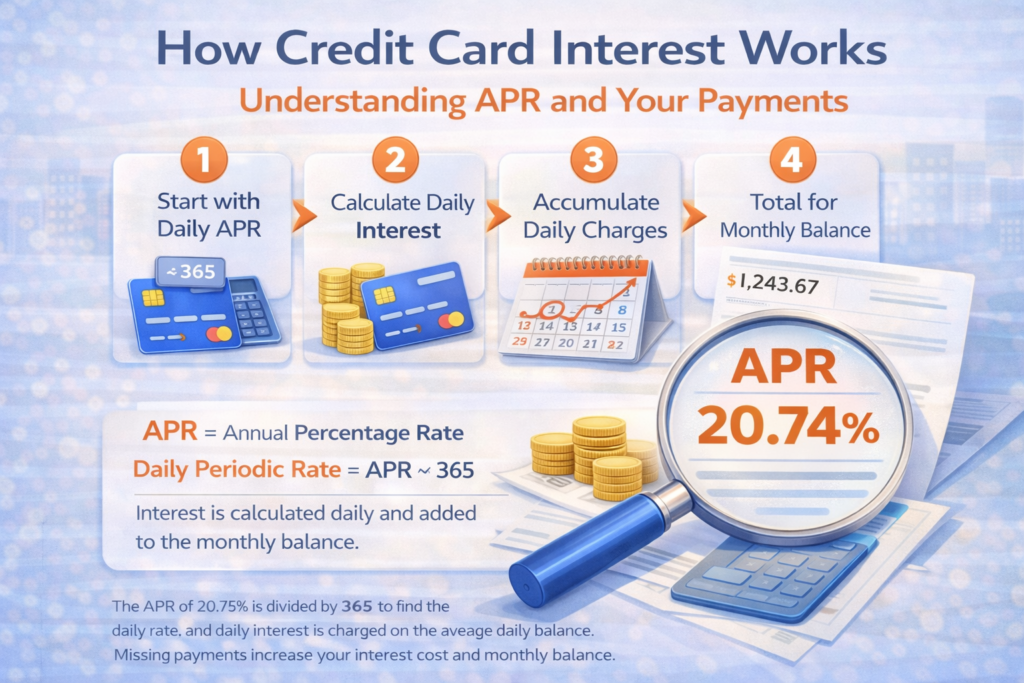
Most credit cards use a method called the average daily balance to calculate interest.
Here is a simplified version of how it works:
First, the APR is converted into a daily rate. This is done by dividing the APR by 365 days.
Then, each day’s balance is recorded. If you make purchases or payments during the month, your balance changes.
At the end of the billing cycle, the card issuer calculates the average of your daily balances and applies the daily interest rate to that amount.
This means interest can build up a little every day if you carry a balance.
The Grace Period
Many credit cards offer a grace period. This is the time between the end of your billing cycle and your payment due date.
If you pay your full statement balance during this period, you usually avoid interest on purchases. However, if you carry a balance, the grace period may not apply, and interest can start accumulating immediately on new purchases.
Understanding whether your card has a grace period and how it works can save you money.
Why Carrying a Balance Is Expensive
Some people believe carrying a small balance helps build credit, but this is a myth. Carrying a balance mainly leads to interest charges.
Even a moderate balance can grow quickly with interest. If you only make the minimum payment, a large portion of your payment may go toward interest rather than reducing the actual debt.
Over time, this can make it harder to pay off what you owe.
Minimum Payments and Interest
Credit card statements show a minimum payment amount. Paying only this amount keeps your account in good standing, but it does not eliminate interest.
When you make only the minimum payment, the remaining balance continues to accrue interest. This can keep you in debt longer and increase the total amount you pay.
Paying more than the minimum, or ideally the full balance, helps reduce interest costs.
Variable vs Fixed APR
Many credit cards have a variable APR, which can change based on market conditions. This is often tied to a benchmark interest rate. If rates rise, your APR may increase.
Some cards may offer fixed rates, but even these can change under certain circumstances, such as missed payments.
Being aware of whether your rate can change helps you plan your finances.
Promotional APR Offers
Some cards offer a 0% introductory APR for a limited time. During this period, you may not be charged interest on purchases or balance transfers.
These offers can be helpful, but it is important to understand when the promotional period ends. After that, the regular APR applies to any remaining balance.
Missing payments during a promotional period can also end the offer early.
Cash Advances and Higher Rates
Cash advances usually have higher APRs than regular purchases. Interest on cash advances often starts immediately, with no grace period.
This makes cash advances one of the most expensive ways to borrow money using a credit card.
How to Reduce or Avoid Credit Card Interest
The most effective way to avoid interest is to pay your balance in full each month. This keeps your account in good standing and prevents interest charges on purchases.
If you already have a balance, paying more than the minimum and reducing your debt faster lowers the amount of interest you pay.
Keeping track of due dates and understanding your card’s terms can also help avoid surprise charges.
Why Understanding Interest Matters
Credit card interest can significantly increase the cost of everyday purchases if balances are not managed carefully. Understanding how APR works gives you more control over your financial decisions.
Instead of letting interest grow your debt, you can use credit strategically and responsibly.
Final Thoughts
Credit card interest may seem complicated, but the basic idea is simple: borrowing money costs more when you take longer to repay it. APR represents that cost over a year, but daily calculations can make balances grow faster than expected.
By understanding how interest works, making on-time payments, and avoiding unnecessary balances, you can use credit cards as a tool rather than a burden.
Pingback: Credit Card Fees Explained (Annual, Late, Foreign, and More)