
Introduction
When your credit card statement lands in your mailbox, there’s usually one number that catches your eye: the minimum payment. It often appears small and manageable, which can make it all too tempting to just pay that amount. While this keeps your account in good standing, it can also quietly trap you in debt for a lot longer than you might expect.
Minimum payments are designed to help you avoid immediate penalties, but they’re not a quick fix for getting out of debt. Understanding how they work is crucial for taking control of your credit card balance and steering clear of long-term financial stress.
What Is a Minimum Payment?
A minimum payment is the least amount you need to pay by the due date to dodge late fees and keep your account in good shape. Credit card companies figure this amount using a formula that typically includes:
- A small percentage of your balance
- Interest charges
- Any applicable fees
Since it’s just a fraction of what you owe, it can seem like an easy short-term fix.
Why Minimum Payments Exist
Lenders provide minimum payments to offer customers some breathing room during tough financial times. Life can throw curveballs — unexpected expenses, emergencies, or a dip in income can make it hard to make full payments.
However, minimum payments aren’t meant to be a long-term repayment plan. They’re designed to keep your account active while interest keeps piling up.
How Interest Changes the Picture
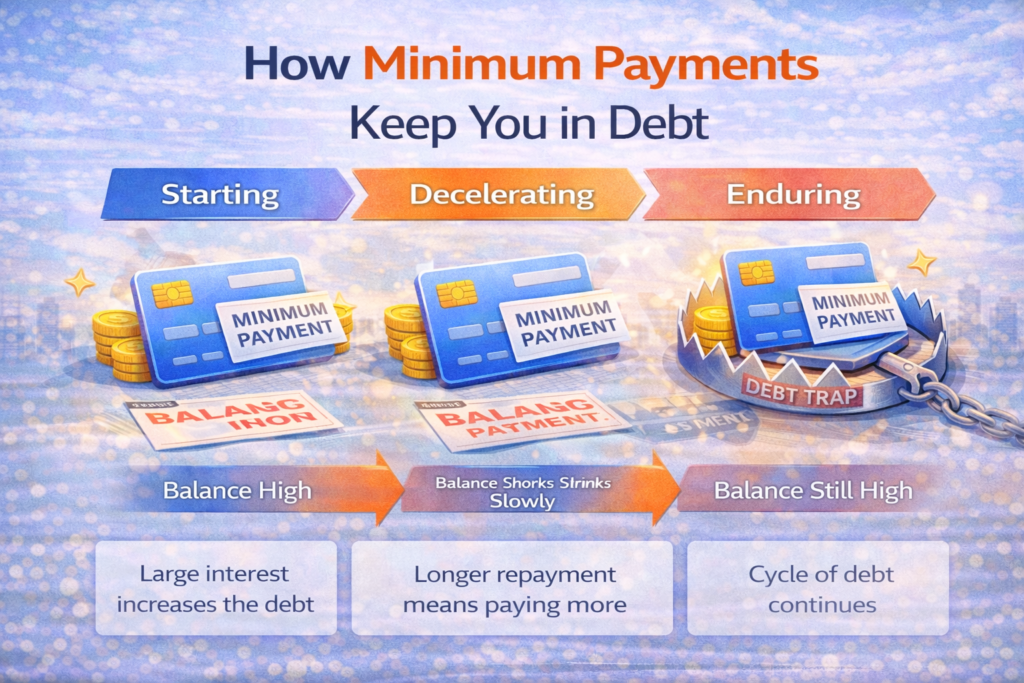
When you carry a balance and only pay the minimum, interest continues to accumulate on the remaining amount. This means your debt doesn’t shrink as quickly as you might hope.
A significant portion of your minimum payment may go toward interest rather than actually reducing the original balance. As a result, your debt decreases slowly, even though you’re making payments every month.
This is why many people feel like they’re “stuck” with a credit card balance.
The Time Factor
Only paying the minimum can significantly prolong the time it takes to pay off a balance. A debt that could be cleared in a year with larger payments might stretch out to several years if you stick to minimum payments.
The Cost of Convenience
Minimum payments can feel like a lifesaver in the short term, giving you a little breathing room. But let’s be real: the long-term cost can be pretty steep. Essentially, you’re paying for the luxury of putting off repayment.
While this might be a necessary move during emergencies, leaning on it too often can trap you in a cycle where debt feels like it’s here to stay.
Why It Feels Safe
Minimum payments can create a misleading sense of security. Since you’re not late and your account is in good standing, it might seem like you’ve got everything under control.
But in reality, your balance might barely budge, and interest is quietly piling up in the background.
How Minimum Payments Affect Your Credit
Making those minimum payments on time helps protect your payment history, which is crucial for your credit score. However, if you’re carrying a high balance, it can still hurt your credit utilization, which might impact your score.
Paying down your balance more quickly can really help improve this aspect of your credit profile.
Breaking the Minimum Payment Habit
To break free from this cycle, aim to pay more than the minimum whenever you can. Even small extra payments can add up over time.
Creating a budget and finding ways to cut back on spending can free up some cash to tackle your balance.
A Smarter Approach
One effective strategy is to set a monthly payment goal that’s higher than the minimum. Treating your credit card payment like any other essential bill can help you stay consistent.
Seeing your balance drop more quickly can be motivating and help ease financial stress.
When Minimum Payments Make Sense
There are definitely times when sticking to the minimum is the safest route, especially during financial emergencies. The key is to recognize that this should be a temporary fix, not a long-term habit.
Once your situation improves, making larger payments should be a top priority.
Final Thoughts
Minimum payments are a safety net, not a solution. They prevent immediate consequences but allow interest to keep your balance alive.
Understanding how they work helps you make better financial decisions and avoid staying in debt
Pingback: How to Use Credit Cards Without Getting Into Debt