
When it comes to personal finance, one of the most powerful concepts you’ll encounter is compound interest. Often referred to as the engine of long-term wealth, it allows your money to grow exponentially over time. While the idea might seem straightforward, many people fail to grasp its true potential.
Getting a handle on compound interest can completely transform your approach to saving and investing. Even modest contributions can blossom into substantial sums if you invest them consistently over the long haul.
Thanks to the internet, anyone can now visualize this growth with the help of compound interest calculators. These handy tools make it a breeze to estimate how your savings and investments might grow over time, taking into account factors like interest rates, time frames, and regular contributions. In this guide, we’ll dive into how compound interest works, why it’s such a game-changer, and how beginners can leverage compound interest calculators to craft a solid long-term wealth strategy.
What Is Compound Interest?
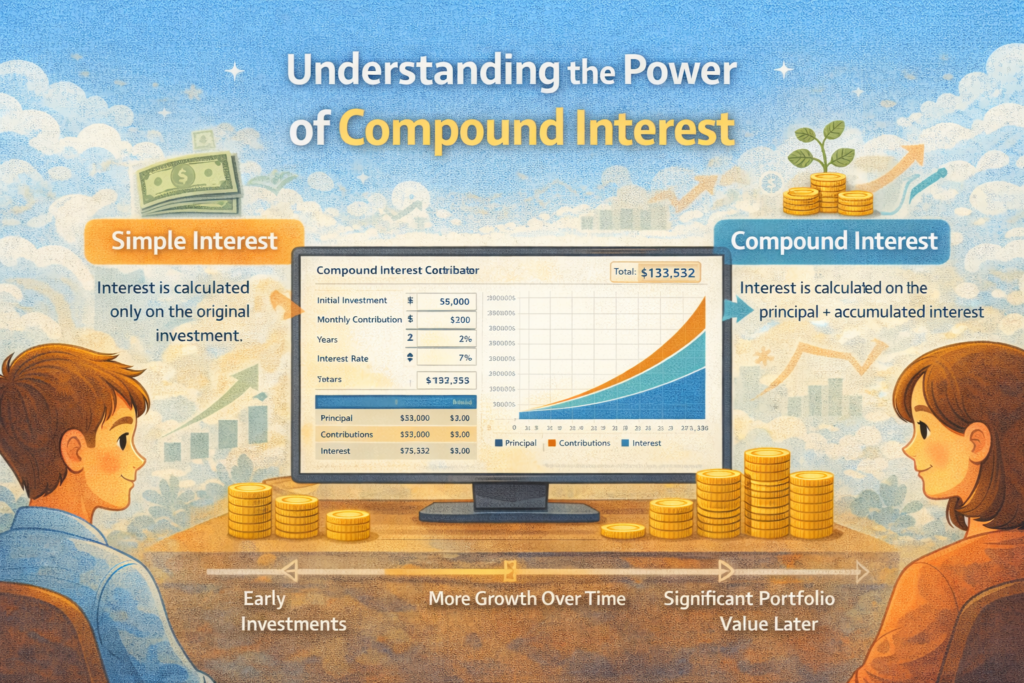
Compound interest is all about earning interest not just on your initial investment, but also on the interest that accumulates over time.
In simpler terms, your money starts to earn returns, and those returns begin to generate even more returns. Over time, this creates a snowball effect that accelerates your growth.
For instance, if you invest $1,000 at a 7% annual return, you’ll earn $70 in the first year. The next year, you’ll earn interest not just on that original $1,000, but also on the $70 you gained in the first year.
This cycle continues year after year, allowing your investment to grow at an increasingly faster pace. The longer you keep your money invested, the more pronounced this effect becomes. That’s why seasoned investors often stress the importance of starting early rather than waiting to invest larger sums later.
Why Compound Interest Is So Powerful
The real magic behind compound interest lies in time. The longer your money stays invested, the more chances it has to grow. A lot of newcomers think that building wealth means making big investments. But in truth, regularly investing over a long stretch is often the key to success.
Take, for example, putting away $200 each month for 30 years with an average annual return of 7%. That could balloon to over $200,000! Without the power of compound interest, those same contributions would only add up to $72,000.
This stark difference highlights how compounding can turn steady savings into impressive wealth. That’s why long-term investment strategies—like retirement accounts and index funds—lean heavily on the benefits of compounding.
What Is a Compound Interest Calculator?
A compound interest calculator is a handy online tool that helps you estimate how your investment might grow over time.
These calculators let you enter a few important details:
- Initial investment amount
- Monthly or yearly contributions
- Expected interest rate or return on investment
- Duration of the investment
- How often the interest compounds
Once you fill in the information, the calculator will provide a projection showing how your investment could grow year after year.
Many of these tools also include charts and graphs that visually represent how compounding speeds up over time. These visuals can be incredibly inspiring for beginners, as they clearly show how consistent investing can lead to impressive long-term gains.
Key Inputs in a Compound Interest Calculator
When it comes to using a compound interest calculator, grasping the key inputs is essential for making the most of it.
Initial Investment
The initial investment, often referred to as the principal, is the starting amount of money you put in. Even if you begin with a modest sum, it can grow impressively over time, especially when you add regular contributions.
Interest Rate
The interest rate is essentially the expected annual return on your investment. Historically, many long-term stock market investments have averaged around 7% to 10% annually after accounting for inflation. While actual returns can fluctuate, this figure gives users a good idea of what they might expect in the long run.
Contribution Frequency
Most calculators let you factor in regular contributions, whether that’s monthly or yearly deposits. Consistent investing is crucial for building wealth over time, as it continuously adds to the capital that can benefit from compounding.
Investment Time Horizon
The time horizon refers to how many years your investment will be active. This aspect has the most significant effect on your final results because the power of compounding increases with time.
Step-by-Step Guide to Using a Compound Interest Calculator
To really grasp how these calculators function, let’s walk through a straightforward example.
Picture this: someone is looking to invest for the long haul and decides to set aside $250 each month into an investment portfolio that’s expected to yield a 7% annual return.
They’re planning to keep this up for 30 years.
Once they plug these figures into a compound interest calculator, they might see a projected final portfolio value of around $300,000 or even more, depending on how often the interest compounds. What’s crucial to note is that their total contributions would only amount to $90,000 over those three decades. The rest of the growth comes from the magic of compound interest.
This example highlights how patience and regular contributions can turn even modest savings into significant financial growth.
Popular Online Compound Interest Calculators
There’s a wealth of free calculators available online that can simplify your financial planning.
Some of the most popular options come from financial education sites, investment platforms, and banks.
These tools often feature interactive graphs that illustrate:
- How investments grow over time
- The total contributions versus the interest earned
- Projections for long-term wealth
Using a variety of calculators can also help you compare different investment scenarios, like increasing your contributions or extending your investment period.
Using Compound Calculators to Plan Financial Goals
Compound interest calculators are more than just tools for understanding investing; they’re also fantastic for planning your financial future. Take retirement savings, for instance. These calculators can help you figure out how much you need to set aside each month to hit your desired portfolio size.
Similarly, if you’re aiming for financial independence, you can play around with different strategies by tweaking factors like how much you contribute and what kind of returns you expect. These projections give you a clearer picture of whether your current saving habits are on track or if it’s time to make some changes.
This kind of insight can really boost your financial discipline and help you stay consistent over the long haul.
Common Mistakes When Using Compound Calculators
While compound interest calculators are incredibly useful, beginners often trip up when using them.
One frequent error is thinking that the projected returns are a sure thing. The reality is that investment returns can vary, and what you actually earn might not match those projections.
Another common pitfall is plugging in overly optimistic interest rates when forecasting future growth. Sure, some investments might see high returns for a short time, but it’s wise to keep long-term estimates more conservative. Typically, a realistic range for long-term stock market returns hovers around 6% to 8% annually.
And don’t forget about inflation—it can really impact your purchasing power over time. Some calculators even factor in inflation adjustments, giving you a more accurate picture of what to expect.
How Compound Interest Builds Financial Discipline
Beyond just numbers and forecasts, compound interest has a powerful psychological impact.
When individuals witness how even small contributions can grow over decades, they start to truly value the importance of being consistent and patient. Rather than getting caught up in the pursuit of quick wins, investors begin to shift their focus toward steady, long-term growth.
Compound calculators play a crucial role in reinforcing this mindset, visually showing that the most significant growth often happens in the later years of investing. This insight helps newcomers stay dedicated to their investment plans, even when the market gets a bit bumpy.
The Earlier You Start, the Better
One of the most vital lessons from compound interest is the immense value of starting early.
Let’s look at two investors:
- Investor A begins investing at 25 years old.
- Investor B starts at 35.
Even if Investor B puts in more money each month, Investor A could still end up with a bigger portfolio simply because their money had more time to grow.
This idea underscores why financial education and early investing are so crucial. Even modest contributions made early in life can blossom into significant sums by the time retirement rolls around.
Final Thoughts
When it comes to personal finance, compound interest is like a secret weapon. It works by letting your returns earn even more returns, which means your investments can really take off over time.
Compound interest calculators are fantastic tools that simplify this concept, helping you visualize how your savings and investments can grow over the years or even decades. For those just starting out, these calculators offer great insights into how making regular contributions, aiming for realistic returns, and practicing patience can lead to significant financial growth.
So, learning to use compound interest calculators isn’t just about crunching numbers; it’s about cultivating a mindset geared towards long-term wealth and financial discipline.
Pingback: Best Financial Podcasts to Improve Your Money Mindset