
Introduction
When you take out a loan — whether it’s for a car, education, or a home — one of the most important decisions isn’t just how much you borrow, but what kind of interest rate you choose. Every loan has an interest rate, but not all interest rates behave the same.
Understanding the difference between fixed interest rates and variable interest rates can help you make smarter financial decisions, avoid surprises, and choose a loan that fits your budget and financial goals.
In this article, we’ll break down both types of interest rates, compare their advantages and disadvantages, explore when each might make sense, and point you to official resources so you can dig deeper. (FDIC Ask)
What Is an Interest Rate?
At its core, an interest rate is the cost of borrowing money — a percentage added to the principal amount you borrow. This percentage determines how much extra you’ll pay over the life of the loan.
Interest rates are influenced by many things, including:
- The lender’s assessment of risk
- Market conditions
- Central bank policies
- Your own credit profile
Interest can remain stable or change over time depending on its structure.
Fixed Interest Rates: What They Are
A fixed interest rate stays the same throughout the entire loan term. This means your monthly payment — at least as it relates to interest — doesn’t change. (Consumer Financial Protection Bureau)
🔹 Example:
If you borrow $10,000 with a fixed rate of 6% for 5 years, your interest percentage remains 6% for the entire 60 months, no matter what happens in the broader market.
Benefits of Fixed Rates
- Predictability
Because the interest doesn’t change, you always know what your payment will be. This makes budgeting easier and reduces financial stress. - Protection Against Rising Rates
If market rates increase, you’re insulated from those changes — your loan costs stay the same. - Easier Financial Planning
With stable payments, it’s simpler to forecast your monthly and long-term expenses.
Drawbacks of Fixed Rates
- Usually Higher to Start
Fixed rates often begin higher than variable rates because the lender assumes the risk of possible future rate increases. - Less Flexibility
You don’t benefit if the broader market interest rates fall — your loan rate stays locked.
In short: fixed rates are all about certainty and stability.
Variable Interest Rates: How They Work
A variable interest rate (sometimes called an adjustable rate) can change over time based on movements in the financial markets. (Consumer Financial Protection Bureau)
Variable rates are typically tied to an index — such as the prime rate, SOFR, or other benchmarks — and a margin set by the lender. When the index changes, your interest rate and monthly payments may also change.
🔹 Example:
You take out a loan with a starting rate of 4%. If the linked benchmark rate rises, your interest could increase to 5% or more. If the benchmark falls, your rate could drop as well.
Benefits of Variable Rates
- Lower Initial Rates
Because lenders share some of the interest-rate risk with you, variable rates are often lower at the beginning compared with fixed rates. - Potential Savings
If interest rates fall, you may pay less overtime. - Flexibility in Some Loan Types
Certain variable-rate loans allow extra features like repayment flexibility or refinancing options.
Drawbacks of Variable Rates
- Uncertainty and Risk
Payments can increase if interest rates rise, making it harder to budget. - Potential Higher Long-Term Cost
If the market rates rise significantly, total interest paid could exceed what you’d pay with a fixed rate.
Variable rates are ideal for borrowers who can tolerate uncertainty and may benefit from rate drops.
Fixed vs Variable: A Point-by-Point Comparison
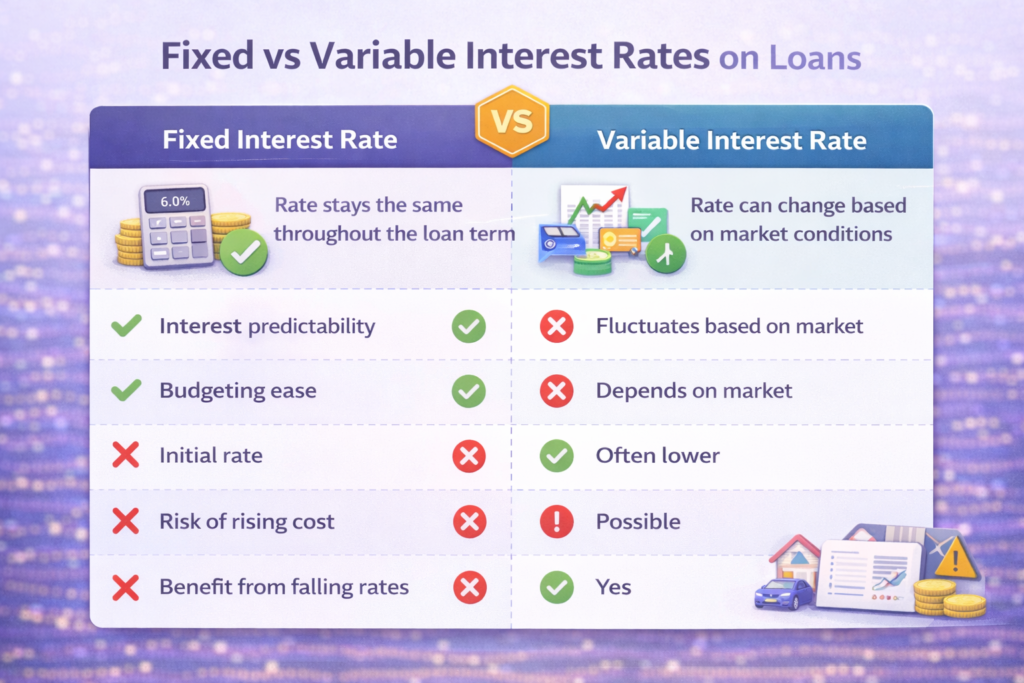
| Feature | Fixed Rate | Variable Rate |
|---|---|---|
| Interest predictability | ✔ Always stable | ❌ Fluctuates based on market |
| Budgeting ease | ✔ High | ❌ Depends on market |
| Initial rate | ❌ Often higher | ✔ Often lower |
| Risk of rising cost | ❌ None | ❌ Possible |
| Benefit from falling rates | ❌ No | ✔ Yes |
How the Market Influences Rates
Variable rates are tied to broader economic indicators. Central banks (like the Federal Reserve in the U.S. or other national banks) adjust base rates to manage inflation and economic growth. When base rates increase, variable loan rates often rise too — and vice versa.
Fixed rates, on the other hand, reflect expectations of future interest moves. Lenders charge a higher fixed rate if they expect rates to rise, protecting themselves from having to lend at a lower cost later.
When Fixed Rates Make More Sense
Fixed interest rates tend to be a better choice when:
✅ You want predictable monthly payments
✅ You’re budgeting long-term
✅ You expect interest rates to rise in the future
✅ You’re risk-averse
Fixed loans work especially well for long-term borrowing like mortgages or long-term personal loans because they shield you from market volatility.
Official lenders and financial regulators often point to fixed rates as the safest choice for borrowers who want certainty in their financial planning.
When Variable Rates Might Be Right
Variable rates can be attractive when:
💡 You plan to repay the loan quickly
💡 You expect market interest rates to fall
💡 You can handle payment fluctuations
💡 Initial cost savings matter more than long-term predictability
For example, if you expect to refinance or pay off the loan in a few years, a variable rate’s lower initial cost may outweigh the risk of future increases. (ISL Educación Financiera)
Real-World Example (Illustrative)
Imagine you are borrowing $20,000:
- Fixed-rate option: 6% interest fixed for the life of the loan
- Variable-rate option: 4% initial rate that could rise or fall
If interest rates stay low, the variable loan might save you money. But if rates rise considerably, your total cost could end up higher than the fixed-rate loan.
This simple scenario highlights why understanding rate behavior matters before deciding.
Risks and Considerations
Variable rate caveats to watch for:
- Rate adjustment caps — limits on how much the rate can increase at once or over time
- Frequency of rate changes
- Market volatility impact on monthly payments (Wikipedia)
Some loans may have protections like interest-rate caps, which limit how high the rate can go, providing some safety net while still allowing the benefits of a variable structure.
Official Resources You Can Check
These sites provide reliable information on fixed vs variable rates:
🔗 Federal Deposit Insurance Corporation (FDIC) – Explains difference between fixed and variable rates:
https://ask.fdic.gov/fdicinformationandsupportcenter/s/article/Q-What-is-the-difference-between-fixed-rate-and-variable-rate?language=en_US (FDIC Ask)
🔗 Consumer Financial Protection Bureau (CFPB) – Difference between fixed and adjustable rates:
https://www.consumerfinance.gov/ask-cfpb/what-is-the-difference-between-a-fixed-rate-and-adjustable-rate-mortgage-arm-loan-en-100/ (Consumer Financial Protection Bureau)
🔗 Standard Bank Guide to Interest Rates – Pros and cons of each type:
https://www.standardbank.co.za/southafrica/personal/learn/what-are-fixed-vs-variable-interest-rates (standardbank.co.za)
What This Means for You
Your choice between fixed and variable things comes down to:
- Your financial goals
- Your tolerance for uncertainty
- Your borrowing timeline
- Market expectations
There’s no universal best answer — only the best option for your personal situation.
Final Thoughts
The difference between fixed and variable interest rates ultimately shapes how your loan behaves over time.
✨ Fixed rates = stability
✨ Variable rates = risk + potential savings
Knowing how these work and using official guidance helps you borrow wisely and avoid surprises down the road.