
Introduction
When it comes to comparing loan offers, most borrowers instinctively zero in on one key figure: the monthly payment. It’s the number that directly impacts your budget, making it seem like the most crucial aspect. However, many people tend to overlook a significant factor that can greatly influence the overall cost of a loan: the repayment term.
The repayment term refers to the duration you have to pay back the loan. While a longer term often results in a lower monthly payment, it also means you’ll be in debt for a longer period — and that can have serious implications. Over time, the length of a loan can add hundreds or even thousands of dollars in extra interest.
Grasping how loan terms function can help you steer clear of selecting a loan that appears affordable but ultimately turns out to be much more costly. Let’s break it down in simple terms.
What Is a Loan Repayment Term?
A loan repayment term is essentially the timeframe in which you agree to pay back the borrowed amount along with interest.
Common loan terms include:
- 2–3 years for small personal loans
- 5 years for many installment loans
- 7 years or more for larger loans
- 15–30 years for mortgages
The term dictates how many monthly payments you’ll make and how long interest will accrue.
The Core Trade-Off: Time vs Cost
Loan terms create a balancing act between:
- Lower monthly payments
- and
- Higher total interest paid
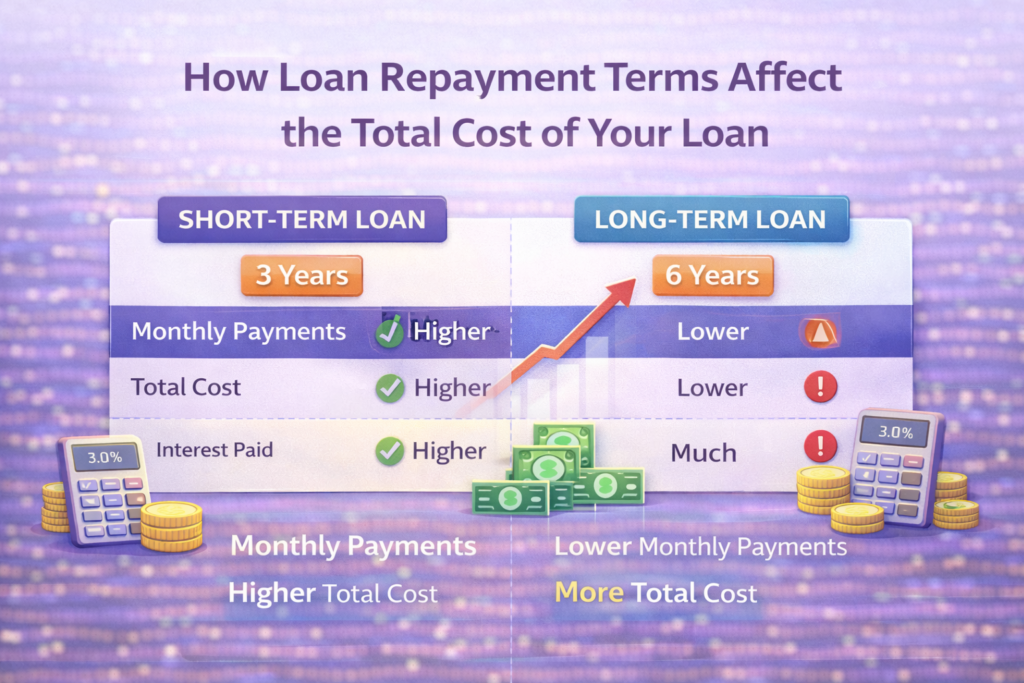
Short-Term Loan
- Higher monthly payments
- Loan paid off quicker
- Less interest paid overall
Long-Term Loan
- Lower monthly payments
- Debt lasts longer
- More interest paid in total
This holds true even if the interest rate remains the same.
Why Longer Terms Increase Total Cost
Interest accumulates over time. The longer a balance remains, the more interest builds up.
Let’s consider a straightforward example:
You borrow $15,000 at a 7% interest rate.
| Term | Monthly Payment | Total Interest Paid |
|---|---|---|
| 3 years | Higher | Much lower |
| 5 years | Medium | More |
| 7 years | Lower | Significantly more |
Even though the 7-year loan may look easier to manage monthly, the total cost of borrowing increases because interest continues for four additional years.
The key idea:
Time is a major factor in loan cost.
The Illusion of Affordable Payments
Longer loan terms can seem attractive because they ease the financial burden in the short term. However, they can create what we might call an affordability illusion.
Paying $250 a month feels much more manageable than $340 a month. But if that lower payment stretches out for an additional two years, you could end up paying significantly more in interest.
Borrowers often get caught up in the immediate comfort of lower payments and forget to consider the long-term financial consequences.
How Loan Terms Affect Your Financial Life
A longer loan doesn’t just mean higher costs; it also impacts your overall financial health.
1. You Stay in Debt Longer
Carrying debt over many years results in:
- Less disposable income
- More financial obligations
- An extended period of financial responsibility
2. Harder to Take New Loans
When lenders assess new loan applications, they take existing debts into account. A longer loan term keeps that debt on your record for a more extended period.
3. Less Flexibility
If your financial goals shift—like buying a home, launching a business, or saving—long-term debt can restrict your options.
Shorter terms allow you to break free from obligations more quickly.
When a Longer Loan Term Can Make Sense
Longer repayment terms aren’t always a bad idea. In certain situations, they can actually help stabilize your finances.
Here are some scenarios where a longer term might be reasonable:
- You’re working with a tight monthly budget
- Your income varies from month to month
- You want a financial cushion
- You need to keep cash on hand for emergencies
The important thing is to recognize that you’re opting for lower payments now in exchange for a higher total cost later.
The Role of Interest Rate + Term Together
Interest rates and loan terms go hand in hand.
A longer term combined with a higher interest rate can significantly amplify the overall cost. Even a slight change in the term can lead to a big difference in the total interest paid.
That’s why it’s crucial for borrowers to compare:
✔ Monthly payment
✔ Total repayment amount
✔ Length of obligation
Not just the payment itself.
Extra Payments Change the Equation
If you’re looking to manage a longer loan term, one effective strategy is to make extra payments.
Here’s what extra payments can do for you:
- They help reduce your principal faster
- They lower the total interest you’ll pay
- They can shorten your effective loan term
Even just one extra payment each year can make a noticeable difference in your overall costs.
Psychological Comfort vs Financial Efficiency
Let’s not forget the psychological aspect of loan terms.
While longer terms can ease stress in the short term, they might not be the best choice financially. Shorter terms often provide better efficiency.
As a borrower, you need to find a balance between:
- Emotional comfort today
- Financial benefits tomorrow
The best choice really hinges on your personal financial situation.
The Smart Borrower Approach
A well-rounded strategy looks something like this:
✔ Opt for the shortest term that fits your budget
✔ Make sure to leave some wiggle room for emergencies
✔ Don’t stretch your finances just to save a little each month
✔ Think about making extra payments whenever you can
This method not only cuts down on total interest but also keeps your payments within a manageable range.
Comparison of two loan scenarios.
Picture this:
Option A
- $12,000 loan
- 4-year term
- $290 monthly payment
Option B
- Same loan amount
- 6-year term
- $215 monthly payment
At first glance, Option B seems like the easier choice. However, if Option A saves you $1,200 in interest over the life of the loan, that lower monthly payment could end up costing you more in the long run.
This highlights the often-overlooked impact of repayment terms.
Key Takeaway
The terms of your loan repayment influence:
- The size of your monthly payments
- The total interest you’ll pay
- The duration of your financial commitment
- Your overall financial flexibility
While a longer term might ease your current financial burden, it can lead to higher costs down the road. Conversely, a shorter term may mean higher monthly payments, but it can save you money and help you pay off the loan sooner.
Final Thoughts
The repayment term is one of the most crucial — yet often misunderstood — aspects of a loan. Many borrowers focus on what feels manageable right now, without fully grasping the potential long-term costs.
Remember, a loan isn’t just about the monthly payment; it’s a long-term financial obligation. By understanding how the length of the term affects your overall costs, you can make choices that benefit your future, not just your immediate situation.
Pingback: How Auto Loans Work: A Beginner’s Guide to Car Financing
Pingback: How to Choose the Right Loan: Understanding Costs, Risks, and Repayment