
Introduction
After learning what a credit score is, the next step is understanding how it actually works in the United States. Many people know the number is important, but they are not sure how it is calculated or how lenders use it.
Your credit score is not random. It is built from your financial behavior over time and helps lenders quickly measure risk. In simple terms, it shows how likely you are to repay borrowed money.
In this guide, everything is explained in a clear and beginner-friendly way.
How the Credit System Works in the U.S.
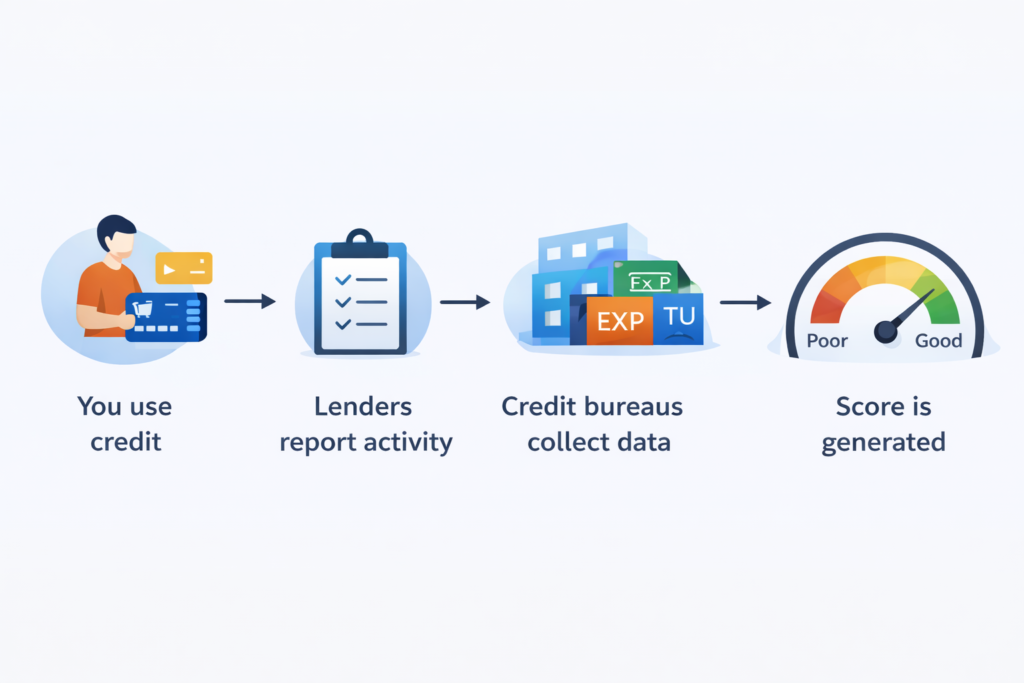
The credit system in the United States is based on tracking how people manage borrowed money. When you use financial products like credit cards, loans, or lines of credit, your activity is recorded.
Banks and lenders report this information to three major credit bureaus:
- Experian
- Equifax
- TransUnion
These bureaus collect and store your credit history in a document called a credit report.
Your credit score is created using the information inside that report.
What Information Goes Into Your Credit Report
Your credit report includes details about your financial habits, such as:
- Payment history (whether you pay on time)
- Credit card balances
- Loan accounts
- Credit limits
- How long your accounts have been open
- New accounts you apply for
This data is updated regularly and forms the basis of your credit score.
How Your Credit Score Is Calculated
Credit scoring models, such as FICO, use formulas to analyze your credit report. While the exact formula is not public, the general factors are well known.
Payment History
This is one of the most important parts of your score. It shows whether you pay your bills on time. Late or missed payments can lower your score.
Amounts Owed (Credit Utilization)
This looks at how much of your available credit you are using. For example, if you have a $1,000 limit and you use $900, that is considered high usage. Lower usage is generally better.
Length of Credit History
The longer you have used credit, the more information lenders have about your habits. Older, well-managed accounts can help your score.
New Credit
Opening many new accounts in a short period can be seen as risky. Each new application may slightly affect your score.
Credit Mix
Having different types of credit, such as credit cards and loans, can show that you can handle various financial responsibilities.
How Lenders Use Your Credit Score
When you apply for credit, lenders check your score to make decisions quickly. They use it to answer important questions:
- Is this person likely to repay the loan?
- How risky is this borrower?
- What interest rate should be offered?
A higher score usually means lower risk, which can lead to better loan terms and lower interest rates.
Why Your Credit Score Changes Over Time
Your credit score is not fixed. It updates as your financial behavior changes.
Your Score Can Increase If You
- Pay bills on time
- Reduce credit card balances
- Keep old accounts open
Your Score Can Decrease If You
- Miss payments
- Use a large portion of your credit limit
- Apply for many new accounts in a short time
Because lenders report information regularly, your score can change often.
Soft Checks vs Hard Checks
Not all credit checks affect your score in the same way.
Soft Checks
These happen when you check your own credit or when companies review your credit for pre-approved offers. Soft checks do not affect your score.
Hard Checks
These occur when you apply for credit, such as a loan or credit card. Too many hard checks in a short period may slightly lower your score.
Why the U.S. System Relies So Much on Credit Scores
In the United States, credit scores are widely used because they allow lenders to make fast and consistent decisions. Instead of reviewing every detail manually, lenders rely on the score as a summary of your financial reliability.
This system makes borrowing faster, but it also means that managing credit responsibly is very important.
Final Thoughts
Your credit score works like a financial report card. It reflects your past behavior and helps lenders predict future risk.
Although the system may seem complex at first, it follows a simple rule: responsible use of credit over time leads to better financial opportunities.
Understanding how your credit score works in the U.S. gives you more control over your financial future and helps you make smarter money decisions.
Pingback: What Lenders Consider Before Approving a Loan